
- Details

This was the fourth time that we have organised the Naar to Upper Mustang GHT trek in Nepal since our first group did it back in 2015. In fact, the last time was in 2018, so we were delighted to get this trek off the ground again in 2025. Naar to Upper Mustang GHT is a camping-style trek exploring a remote area that is rarely visited by trekkers. The Teri La is a more challenging pass compared to the more commonly crossed passes from the Annapurna region into the Kali Gandaki valley, such as Thorung La and Mesokanto La above Tilicho Lake.
Our Nepalese Sirdar and group leader was Arjun Tamang, and the assistant guides were Bishal Shrestha and Bishal Lama. As usual, we had an international group with trekkers coming from the UK, USA, and Canada. They arrived in Kathmandu on October 11th, and fortunately, the weather forecast for the foreseeable future was sunny and stable. It is worth pointing out that we carefully select the start dates of our treks to increase the chances of fine weather and conditions. These days, the monsoon tends to go on for longer than in the past, often with lingering cloud into the middle or even late October (as happened in Autumn 2024).
However, the Autumn 2025 season had a very different weather pattern from previous years. On October 4th and 5th, there was very heavy precipitation from a cyclonic system coming from the Bay of Bengal, which had moved out of Nepal by the 7th. After that date, we had perfectly sunny weather until October 27th when Cyclone Montha came in, bringing another burst of heavy precipitation throughout the Himalayan region. Therefore, our Naar to Upper Mustang GHT had clear and sunny weather with wonderful mountain views for the majority of the trek. A few days after crossing the Teri La pass, the skies clouded over...
I am based in Kathmandu during the peak months of the Spring and Autumn season, and one of my jobs is to monitor the weather forecast. Around October 20th, I noticed a low-pressure system was forming in the Bay of Bengal, and forecasts indicated it would take a week or so to arrive in Nepal. Therefore, given this timeline, I knew that our Naar to Upper Mustang GHT group would be able to safely cross the Teri La pass in fine weather. I was in communication with Arjun via the satellite phone and let him know that the weather would deteriorate by the time they got to Yara village on October 28th. In practice, the weather forecast was correct, and Cyclone Montha brought snow and high winds into the mountains. Our group was fine, given that they were at a lower altitude on village trails, so not in an exposed location. There was snow on the trail to Lo Manthang, although most of it melted in the afternoon.
It was sad to see that many other trekking groups and expeditions in Nepal were severely affected by Cyclone Montha, with multiple fatalities and rescues in the mountains. This was entirely preventable if they had been monitoring the weather forecasts.
Given the bad weather conditions at the end of the trek, there was no chance of flights operating from Jomsom to Pokhara, so we decided to drive down the Kali Gandaki valley. We were concerned about the risk of landslides blocking the road, although the group got away early from Jomsom and drove with no issues all the way to Pokhara in one day. Unfortunately, our crew didn't have the same luck as shortly after they left Lo Manthang, there was a landslide near Tsarang village in Upper Mustang, and their bus was stuck there for three days! It was frustrating for the assistant guides and porters who wanted to get home, although they finally got going after the landslide had been cleared by bulldozers.
Overall, this trek went very well, and we received positive feedback from the group. Thanks to Richard H and Richard C for their AITO Traveller Review for Naar to Upper Mustang GHT. You can read more about Richard C’s experience in his informative and helpful review copied below:
"Naar to Upper Mustang- remote trekking in Nepal at its best. We immediately left the hustle and bustle of the Annapurna Circuit behind and trekked through a beautiful, forest-sided river valley towards the remote and atmospheric village of Naar. At 4,100m, Naar sits above the tree line in an open valley with a semi-circle of traditional, flat-roofed, stone buildings sandwiched together overlooking terraced fields and all surrounded by snow-dusted mountains. From Naar, the trek took us up even more remote valleys, aiming for the 5,595m high Teri La pass leading towards Mustang. After leaving Naar, we only saw three other trekkers before we dropped down into Mustang. This section offered wonderful walking on narrow, undulating paths surrounded by amazing views of multi coloured, snow-capped mountains. The scenery on reaching Mustang was different, but no less impressive, with a high arid plateau cut through by river valleys, resulting in almost vertical fluted edges, which from a distance appeared impregnable. We visited three villages of interesting but differing character en route to our destination of Lo Manthang, climbing up and over the plateau each time. Some snow towards the end of the trip changed the views from yellow hues to white, but they were still of equal beauty. Overall, a fantastic camping trip which takes you away from the beaten track and into areas seldom visited by people other than the local Yak herders.
This was our first trek with The Mountain Company, and we were very impressed with the overall organisation and range of trips offered. The pre-trip information is comprehensive, and Roland was quick to answer any additional questions we had. We very much appreciated the hard work of our trekking crew and the excellent way they looked after us. Roland's monitoring of the weather forecast and regular communication with our local guide meant that they were able to agree on the necessary, weather-enforced changes to our travel arrangements towards the end of the trip. We will certainly look at travelling with The Mountain Company again."
One of the reasons that I am based in Kathmandu during peak season time is to meet our groups when they get back from their trek for a debrief in person. On November 1st, I met up with the group at Hotel Ambassador to discuss how the trek went and to listen to their feedback. We also received post-trip feedback forms from most of the group after returning home. As mentioned, the trek went well, although we have decided to make a few changes to the itinerary to make it even better for future groups. Our 2026 itinerary is one day shorter at 22 days. The changes are as follows:
1. At the start of the trip, we will drive further up the Marsangdi valley via Dharapani (where we stopped our drive in 2025) to Koto. It is now a busy road from Dharapani to Chame/Koto due to the construction of a hydro power station, so it is no longer enjoyable to walk this section.
2. We have reduced the number of trekking days by one. It is possible to walk from Tangge village to Yara village in one day without stopping overnight at Dhye Thangchung (known as Riverside), as we did with past groups.
3. We have now included two nights in Lo Manthang rather than just one night. This means that we have a full day to explore by jeep north towards the Tibetan border and to visit the caves and monasteries. There is also more time to visit the Walled City in Lo Manthang.
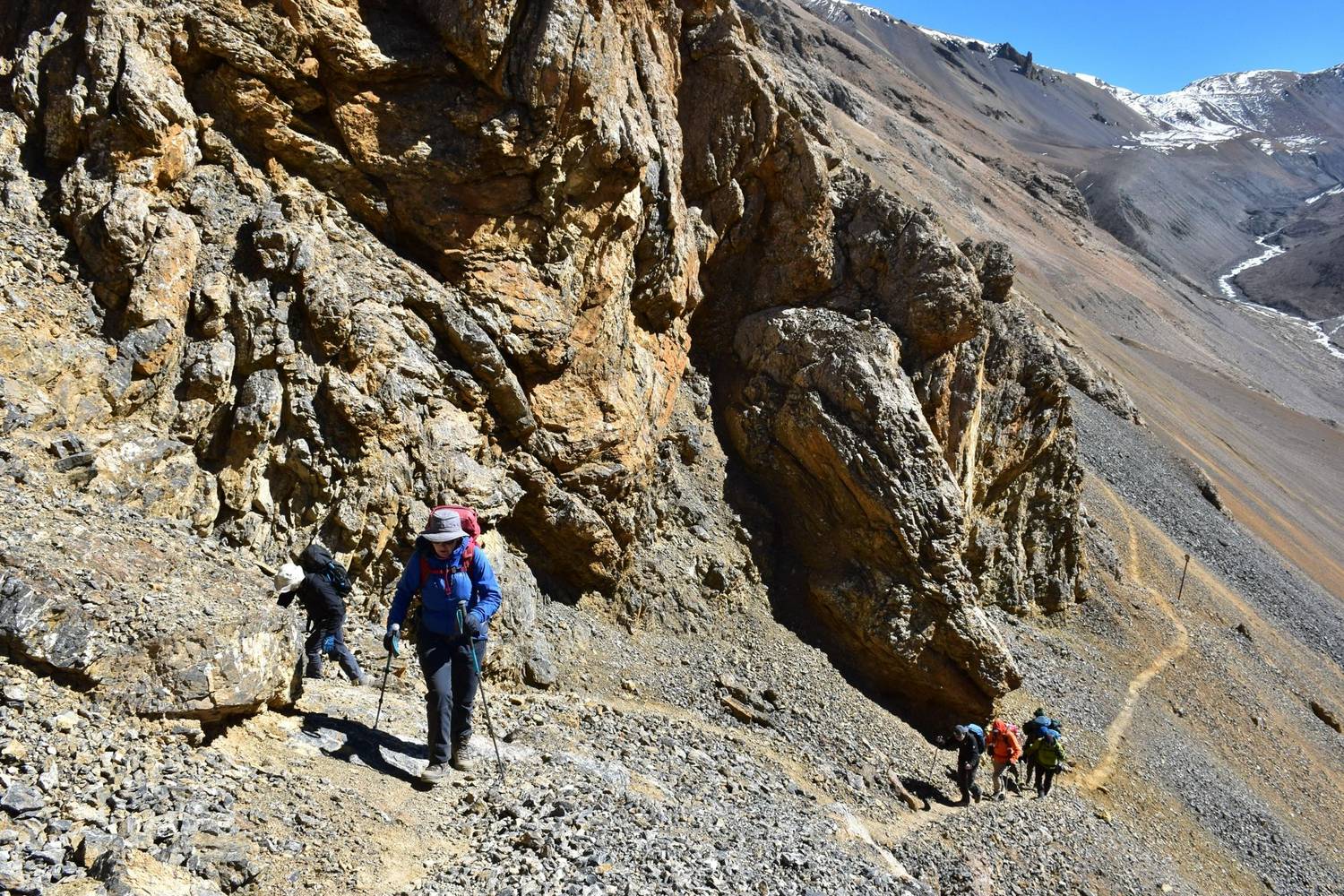
It is worth pointing out that the feedback from the group was that the trail on the descent of the Teri La was more challenging than they had expected. I have copied Richard C’s feedback on this section as follows: “Once over the pass, there is a steep and rocky initial descent before a series of long traverses on a very narrow path which cuts across steeply sloping hill sides. It requires a fair bit of concentration and involves going over three shoulders before the zig-zag descent down to the campsite finally comes into view.“ From speaking with Arjun, it sounds like the cyclone in early October 2025 or, perhaps, the heavy monsoonal outburst in late September 2024 has further eroded this section of the trail, making it more challenging since we last did this trek back in 2018.
If you are considering doing a trek along The Great Himalaya Trail, then you need to be confident walking on rocky and exposed trails like the descent of Teri La. As these trails are not walked on very often, they are not maintained by the locals like on the classic treks in the Annapurna and Everest regions. The trail conditions can change from season to season and from year to year. GHT treks are not for everyone, and that is why we carefully screen our trekkers to ensure it is the right objective for them, given their fitness, experience, and any medical issues. You need to be aware that the itinerary could change depending on weather conditions or other factors, so come with an open and flexible mind. If you are up for a challenge, then GHT treks offer a rare opportunity to walk on quiet trails with very few other trekkers around and to visit remote areas in Nepal.
Well done to the group for completing this challenging GHT trek. Thanks much to all of our guides, cooks, and porters who worked hard to support this group. Great job!
We have already received strong interest in Naar to Upper Mustang GHT for October 2026. If you are considering joining this trek, please get in touch with us, and we can discuss further on an online call on Google Meets.
Trek on!
Roland Hunter
The Mountain Company