

- Details

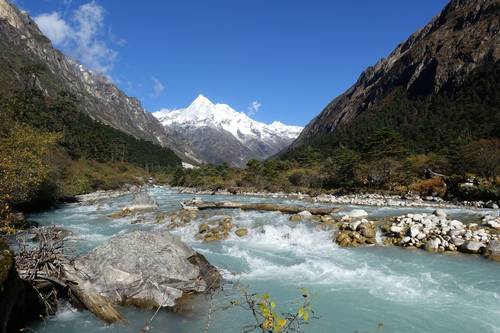
This is our fourteenth time that we have organised the Complete Lunana Snowman in Bhutan since 2008. Overall, it went very welll and they all of the group successfully made the traverse to Bumthang. So we have maintained our 100% success rate in organising the Snowman trek in Bhutan. Our international leader was Almas Khan, and this was his twelfth Snowman. Almas worked with our regular Bhutanese guide, Tshering Dorji, who has worked with us since 2008. We also had our regular cook and general organiser on board, Tandin Sonam. As usual for our Lunana Snowman trek, our 2025 group was international, coming from the UK, Germany, Switzerland, and the USA.
Almas sums up his experience leading this group:
“This year's Snowman trek had very good weather after we left the Chomolhari Base Camp. The weather this year was definitely a highlight as we got some amazing views and no precipitation throughout the trek. Acclimatisation day at Haa worked great once again as the whole group acclimatised very well and we did not have any altitude-related sickness or symptoms.
It rained a lot till we got to Chomolhari Base Camp (Jangothang) on Day 2, the rain was followed by snow at Base Camp, where we had a rest and acclimatising day - that's when the weather started clearing. On the following day, we went over the Nyele La pass on a sunny, clear, warm day with zero winds. There was about one foot of fresh snow on the pass, but track conditions were great for trekking and also good for the pack animals (horses). This good spell of weather lasted the whole trek. When we got to Bumthang, it started raining again, and it rained for three days in a row as we drove back to Thimphu and Paro.
The group as a whole walked well and got to all camps in very good times; Day 1 from Shana to Soi Thakthanka was our longest day, time-wise, as always. The food prepared by our chef, Tandin, was loved by all, and we had no stomach-related problems throughout the trek. The group loved interacting with the staff, and they all did a great job to make this trip successful and enjoyable. Of note for future groups, there was no electricity in Laya for the group to charge their gadgets, but the solar chargers carried by the group worked very well.”
As Almas says, there was heavy precipitation at the start of the trek and when in Bumthang the day after they had finished the trek. Both of these weather events were generated by cyclonic systems coming from the Bay of Bengal. It is very unusual to have two cyclones impacting the Himalayas in the Autumn season. As discussed in previous trip reports, selecting the start date of the Snowman is critical for a successful trek. For example, if we had started a few days later, then it is likely that the high passes out to Bumthang would have been blocked by snowfall from the second cyclone (Cyclone Montha). The early cyclone did not deposit too much snow on the first pass, as it is not too cold at this time of the year, so it is wet snow falling on warm ground, which melts off quite quickly. Whereas later in October, the temperatures have cooled down as winter is approaching, so there will be much more snow that will probably stay on the passes through to Springtime.
Overall, I think our Snowman 2025 group had the best weather conditions out of our fourteen Snowman groups we have organised since 2008. As Almas says, after crossing the first pass on October 6th, they had blue skies and sunny weather for the entire trek until a few cloudy days towards the end due to the approaching Cyclone Montha. With past groups, the weather pattern has been cloudy afternoons through to mid-October and progressively clearer weather as the high pressure starts to move into the Himalayas.
Given the increasing volatility of the weather, it is even more important to for trekking operators to carefully monitor the weather forecasts. As many of you know, I am based in Kathmandu during the peak seasons of Spring and Autumn, and one of my jobs is to look at the weather forecasts. Both of these cyclonic systems came from the Bay of Bengal and took about a week to move up through India before impacting the Himalayan region. I saw both cyclones forming in the Bay of Bengal, and so knew they were a risk, so we had ample notice. The cyclone's tracks change as they develop, although a few days out, the location and severity of the storm are always known. I am in communication with our group leaders on a daily basis and keep them informed of the current weather forecasts. It was very sad to see the multiple fatalities and rescues in Nepal from both of these cyclones, as many groups were simply unaware of these storms approaching.
Thanks to Matt S from our Snowman 2025 group for his AITO Traveller Review for Lunana Snowman. You can read more about his experience below:
“A well-organised trek in a wonderful part of the Himalaya. Trekked the 'longer version' of Bhutan's famous "Lunana Snowman" trek: nearly one month of walking through incredibly beautiful scenery and remote villages. Our trek was organised by UK-based Roland Hunter, of The Mountain Company. Roland is legendary for his superb customer service, putting the needs of his customers above commercial gain. No corners are cut in his efforts to make his treks as well-run as possible, such as allowing plenty of time for acclimatisation, and using the best local guides and staff.”
We have already received strong interest for our Lunana Snowman trek in Autumn/ Fall 2026, and Almas Khan has confirmed that he would like to lead this group again. Please get in touch with us if you are interested in joining this group.
Congratulations and well done to the trekkers. Thanks to the guides and trek crew for their hard work, great job!
Trek on…
Roland Hunter
The Mountain Company