
- Details

In May 2026 we organised our eighth group doing the Upper Dolpo to Upper Mustang GHT trek in Mid-West Nepal. As you will read in this Trip Report, since our first trek in 2010 there have been a number of significant changes to this region of Nepal. Our leader for this group was Dorji Lama and supported by the assistant guides: Tanka, Kabi and Suman. Our porter leader was Norbu and our cook was Tshering. We had a group of nine trekkers coming from the UK, USA and Australia. Interestingly one of the trekkers, Chris, had done our Upper Dolpo trek with us in 2017 and came back mainly to walk out over our new exit pass, the Ghami La, from Upper Dolpo into Upper Mustang. In the past we crossed the Sangda La out to Lower Mustang however there is now a road over this pass. We changed our itinerary for our May 2024 group and so this year we had our second group crossing the Ghami La at an altitude of 5,705m.
Despite the unstable spring weather reported in our June 2026 e-newsletter our Upper Dolpo to Jomsom GHT trek set off in fine weather with a scenic mountain flight to the remote airfield in Juphal. Over the course of the next week or so, with the weather staying stable, and having spent the necessary days acclimatising close to the beautiful, sacred, Phoksundo Lake, the whole team successfully crossed their first pass at 5,300m and descended into Upper Dolpo and to the monastic compound at Shey Gompa. During this part of the trek the group were passed by many local inhabitants who were moving to the high altitude pastures to harvest cordyceps (also known as yarsagumba), which are highly prized in traditional Chinese medicine.
Trekking Passes Over To Shey
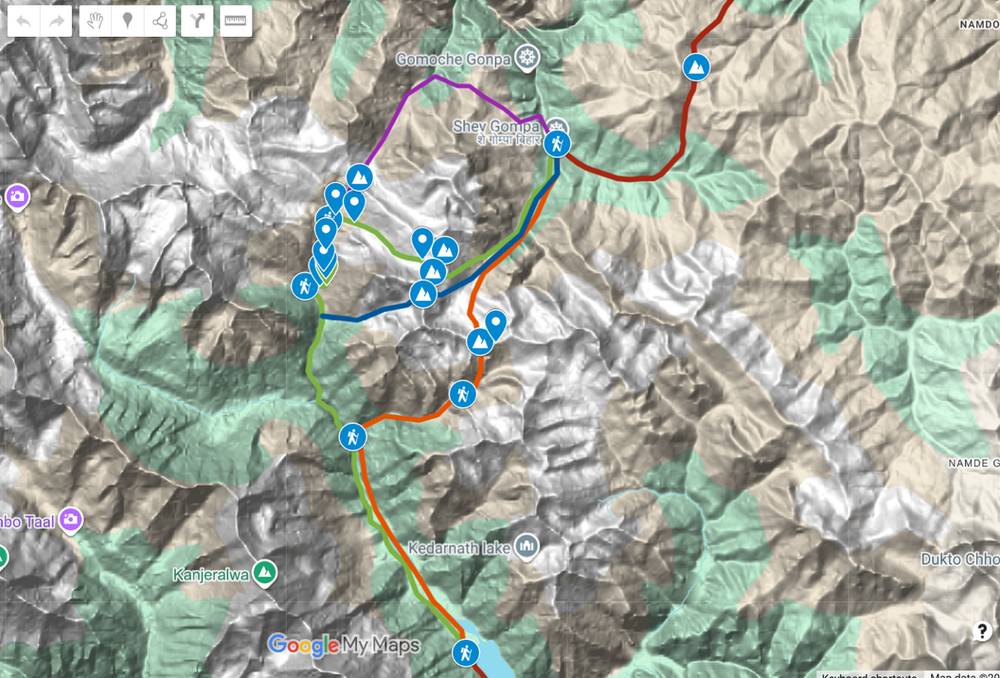
There is often confusion regarding the location of the Snowfields camp and the various passes leading over to Shey. The Snowfields Camp was used by Peter Matthiessen who was the author of the classic book called The Snow Leopard. In fact there are four passes over to Shey (and likely several more). To make things easier, I have updated our Google Maps for Upper Dolpo to Upper Mustang GHT with these routes highlighted in four different colors, labelled as Passes A, B, C, and D.
Part of the confusion stems from the fact that local names for these passes often change year to year depending on who you speak to. Here is a quick breakdown of how they differ:
- Pass A (Churan La — Green Line): This is also the route I took during my initial recce trek with Ade Summers back in May 2010. Ade Summers led our groups over this pass in May 2014 & 2016, Jason Day in May 2022 and Nat Wilson in May 2024.
- Pros/Cons: It is highly scenic and excellent for acclimatisation, but it tends to be steeper and hold more snow than Pass B.
- Pass B (Kang La or Ngandra La — Red Line): This is the original route Peter Matthiessen used. This is the pass our group crossed this year. Over the last five years, more trekking groups have shifted to this route. In practice our High Camp at an altitude of 4,600m is lower than Matthiessen's "Snowfields" camp which is about 5,000m.
- Pass C (Purple Line): Almas Khan’s group successfully crossed this pass to Shey in May 2018, starting directly from High Camp before Pass A (Churan La).
- Pass D (Blue Line): We have never had a group cross this way so we don’t know what the trail is like although we heard it is used by some trekking groups.
Optimate dates for late Spring season trek in Upper Dolpo
These days Himalayan weather is nothing if not unpredictable. Looking at the unstable weather in April 2026, it looked a lot like the Spring 2023 season. Back then, fortunately we didn’t have a group although we heard reports of other trekking groups being forced to turn back from the high passes into Upper Dolpo. Learning from the Spring 2023 season, we shifted our late Spring departure from May 7th to May 17th. Those 10 days make all the difference. It allows the heavy snow accumulated during March and April to melt, opening up the trails. We can't push it back any later, as the monsoon starts rolling in toward the end of June, making mid-May the optimal window.
Given the heavy snowfall earlier this Spring (March and April), Dorji made the right call to cross Pass B (Kang La or Ngandra La). Feedback from locals in Ringmo village suggested Pass A might still be blocked by snow, making Pass B the safer, open alternative. From discussions with Dorji and the group, there were a few patches of snow on Pass B although they crossed over with no issues on May 26th.
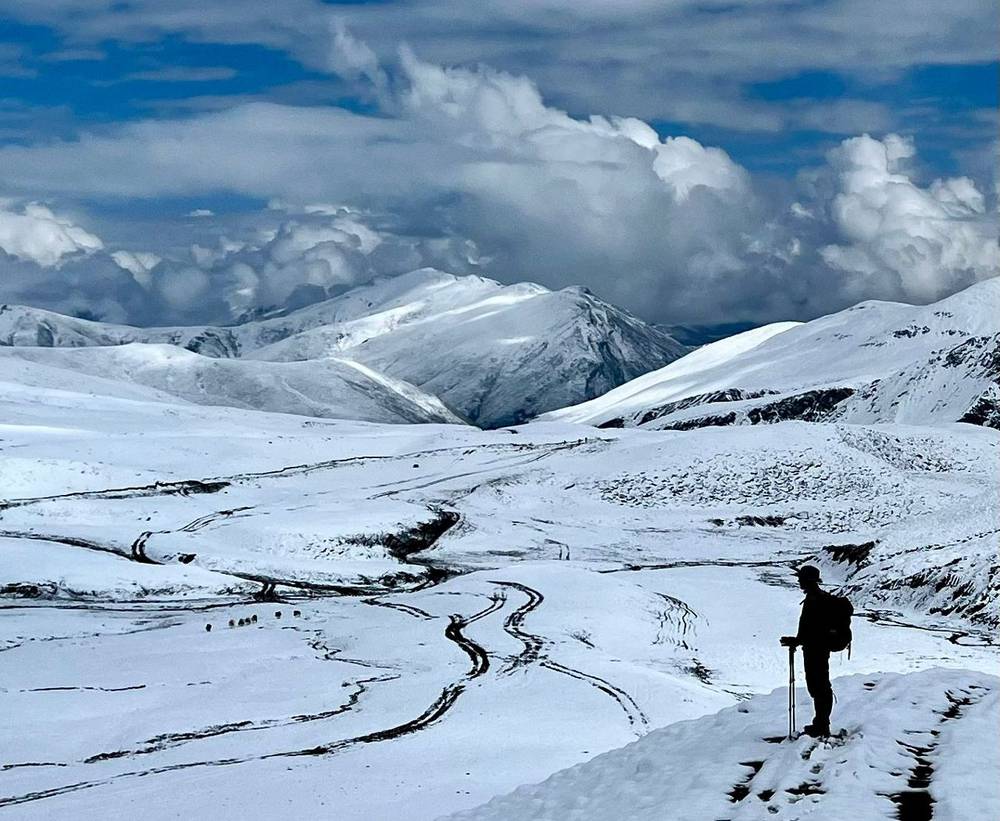
Overall the weather was pretty good throughout the trek. The mornings were bright and sunny and some clouds tended to build up around midday. For a few days in early June there was a low pressure system to the east of Nepal causing light precipitation in the afternoons and evenings. On the day crossing the Mu La (see the photo above), a small amount of snow fell overnight although it quickly melted in the sun given the ground is warm at this time of year. The team continued as planned up the short climb to the pass and downhill to the village of Chharka. Fortunately after leaving this village, the changeable weather was behind them and the reports received over the satellite phone were accurately forecasting fine weather all the way to Ghami.
Current status of road building in the Upper Dolpo region of Nepal
After a rest day at Shey Gompa the team headed up their second pass. For this second part of the trip, the significant change since our last trek to Upper Dolpo in May 2024 are the newly built roads on several sections of the trek. I was interested to find out more about how the recent road construction affected the trekking experience in Upper Dolpo.
One of our trekkers, Colin, summarised the road situation “They are graded (soft top) and probably about eight foot wide, the construction has made it quite a gentle gradient rather than a footpath following the lay of the land. We saw a handful of motorcycles but no jeeps yet. These tended to have been put in where the previous trails had been so there was limited opportunity to get off them. There was hardly any traffic but it was dusty and felt rather more developed than it probably was because of the road. The trek is still interesting to do because the landscape, geology and culture is very different from the high mountain regions ”
The word “road” is quite nuanced as discussed by one of our trekkers, Chris, in this group who had also booked this trek with us back in May 2017. Chris summarises his thoughts as follows “Personally I didn’t mind it because the scenery remained as beautiful as it was in 2017 no matter what surface you were walking on. People wouldn’t have realised that the road has been built almost directly on top of the old trail. Which in 2017 due to the nature of the open landscape was a very wide trail anyhow, almost as wide as the road in places.”
It will be helpful for anyone looking to book this trek in the future to understand the extent of roads encroaching on this trek in Upper Dolpo. There are jeep tracks/ roads on the following sections:
Day 14: after leaving Shey on a trail they picked up the jeep track at the top of the Saldang La and followed it to Namrung village. It is likely the road will be built to Shey in the near future. Road walking: ½ day
Day 15: walked on a jeep track from Namgung to the viewpoint just before Saldang and then a trail for the last 30 minutes into Saldang. From Saldang to Karang was all road plus 15 to 20 minutes after leaving Karang. From there it is a lovely trail on a terrace over the side valley ridges. The road is currently being built from Tora Sumna towards Karang, although it is down in the main valley so we should be able to use the same trail on the terrace to avoid walking on it in future years. There was a 20 to 30 minute walk on the road before Tora Sumna. Road walking: 3 1/2 hours (out of 5 hours walking).
Days 16 & 17: on a road for an hour from Tora Sumna to Yanger gompa then on a trail to Mischagaon and over Muri La to Chanpola Goth near Shimen village (4,195m). Road walking: 1 hour.
Days 18 to 21: followed a jeep track most of the way from Shimen to Chharka. After Tinje most of the traffic seemed to go on the other side of the river, and the road we were on wasn't passable to anything other than motorbikes due to landslips. Road walking: 4 days.
Day 22: the road extends out of Chharka on the north side of the Chharka Tulsi Khola, but only for an hour or so. We crossed over a stream and kept hiking east, and then it was nothing but a trail until Ghami village. Road walking: 1 hour.
As you can see from the above there is about 5 ½ days of walking on a road out of the total number of 25 trekking days. In summary there are no jeep tracks on these sections of the trek:
- For the first 10 days of the trek we walk on a trekking trail from near Dunai up to Shey Gompa.
- For 3 days from Yanjer Gompa to Chanpola Goth near Shimen we walked on trails (there was only one hour of roads on the section from Tora Sumna to Yanjer gompa). As one of the trekkers said after the trek “The valley from Tora Sumna to the Yanger Gompa (the color of the river, the wild roses, the large, round, white carved river rock piles—and going inside the Gompa especially the second room with the paintings and chortens and then along the gorge where the valley narrowed was a definite trek highlight for me.”
- After an hour of Chharka village, we followed a remote trail for 4 days over the Ghami La to Ghami village. This last section of the trek was described by one of our trekkers as “Honestly, I thought this last stretch was spectacular - high and remote, vast views. That last day’s trek around the gorge as you descend towards Ghami village was the most exciting on the trek - not your typical trudge getting to the trailhead. It would be unfortunate to lose that section based on a re-route to avoid the long road between Shimen and Chharka.”
Another of our trekkers commented “The new jeep tracks were free from traffic, barring the odd motorcycle. They had been built over the original trails so for long periods there was no alternative other than to continue along them. Despite the new roads the trek retained its feel of remoteness: only one group and a couple of individual trekkers were seen after leaving Shey Gompa; much of the next week was spent on quiet but dusty jeep tracks, interspersed with terrace and dramatic gorge walking, visiting remote settlements and the ancient Gompa at Yanjer.”
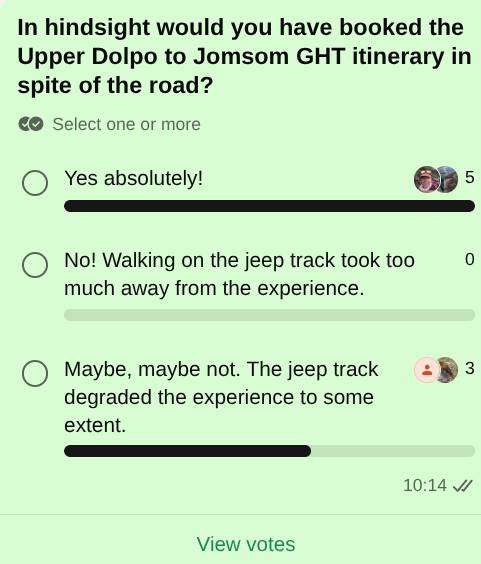
We set up a WhatsApp group for our Upper Dolpo group and I added a poll with a question “In hindsight would you have booked the Upper Dolpo to Jomsom GHT itinerary in spite of the road?”. As you can see there were mixed results although the majority (five people out of eight) responded saying yes they would have still booked the trip. The word “road” is quite nuanced as per Chris’s comments from earlier. As he says, even before the jeep tracks were constructed due to the nature of the landscape the trails were always quite wide and flat (and therefore not too dissimilar to a jeep track). Plus of course it is an arid environment so it has always been a dusty place. The bottom line is that it is important for anyone looking to book this trek in the future to know about these jeep tracks and the impact on trekking in Upper Dolpo.
Crossing the Ghami La Pass to Upper Mustang
As mentioned above after our Upper Dolpo trek in May 2022 we changed our itinerary to cross a new exit pass called the Ghami La (5,705m) from Upper Dolpo into Upper Mustang. In the past we crossed the Sangda La (where the road now goes) and from May 2024 we started crossing the Ghami La which is now the highest pass on this trek. This is a wonderfully remote section of the trek described in one of our AITO Traveller Reviews for Upper Dolpo to Upper Mustang GHT as “The new exit via the Ghami La adds to this trip, being very remote, using a route that is rarely taken even by the local herders and traversing terrain that is stunning in its beauty and isolation. This is well worth the extra cost for the additional Mustang permit.”
One of the trekkers in this group, Nicola, commented “Beyond Chharka the trails are less well defined, narrower, rougher and rockier, and we said good-bye to the mule team and continued with porters for the final third of the trek. The team decided to forego a planned rest day in Chharka and to push on, shortening a couple of longer days on the approach to the Ghami La pass, the fifth, final, and highest, of the 5,000m passes on this trek. After a 2-3 hour climb all of the team made it to the pass at 5,700m where a well earned rest, photographs and snacks were taken. Having now crossed from Dolpo into Upper Mustang the final day trekking down to Ghami village was not a typical walk out day and was a highlight for the team in its own right.”
Colin describes crossing the Ghami La “The path was largely comfortable given our acclimatisation and didn’t feel overly challenging but it was steep and rocky in places. At one point there was about 100m of steep rock hopping /scrambling. The descent was easy - not steep and it was sound underfoot. I actually felt the scenery and terrain was more varied than anything around Shey so we finished on a real high; the trail from high camp down to Ghami was one of the best walkout days I’ve had. My overall thoughts for the trek If I break it into thirds: the best being from Chharka to Ghami, second best was from Juphal to Shey, third best was Shey to Chharka (because of the roads) but there were individual highlights along the way in each section.”
Snow Leopards in Upper Dolpo
Sadly, luck wasn't on our side this year—the group didn't spot any snow leopards this time around. That being said, in one of the camps before Chharka the group saw snow leopard prints and scat. Also, the evening before, dogs belonging to a goat herder had been barking throughout the night. As reported in our Trip Report, our Spring 2022 Upper Dolpo group had the unforgettable experience of spotting a snow leopard in the same area. Check out the incredible "Amateur footage of a snow leopard, filmed in Dolpo, Nepal" on YouTube. Also, in the morning the group found wolf prints around Tora Sumna camp. It is an amazing feeling to know these wild animals are in close proximity and is what makes the Upper Dolpo region so special!
A celebration dinner and thank-you was organised that evening in Ghami before the team started the two day journey back to Kathmandu. As Colin says “The team would like to thank Dorji Tamang (guide) and the rest of the excellent team for all their hard work and for making this a memorable trip to a rarely visited part of Nepal.”
We plan to arrange our Upper Dolpo to Upper Mustang GHT trek again in May/ June 2027 so please get in touch if you are interested in joining this group. I would be happy to discuss this trek further on an online call to tell you more about the Upper Dolpo region and reply to any of your queries.